
Office Move Checklist: How to Relocate a Miami Business Without Downtime
Moving an office in Miami is a thrilling experience for any expanding company, but it demands lots of preparation. From moving the computers to preparing the employees and organizing the entire office, any slight mistake may affect your productivity adversely.
Fortunately, an effective plan can assist in making your office relocation process much smoother and faster. An office move checklist will enable you to coordinate all tasks, responsibilities, and even the attention of the employees.
Key Takeaways
- Begin your office relocation process well in advance, six to eight weeks ahead of moving time, depending on how large your organization is.
- Make a list of all office furniture, electronics, paperwork, and other equipment.
- Plan for the move during off-hours or during weekends to avoid any inconvenience.
- Work out with your IT department about preparing the computer network, server, internet connection, and telephone systems.
- Contract professional movers who have experience in moving commercial offices.
- Test the important systems in the new office before everything returns to normal.
1. Six to Eight Weeks Prior to Relocation: Design Your Relocation Plan
The first step in any effective office relocation involves developing an appropriate time frame. You need to check your new office location, terms of the lease, access, and expected move-in date.
Identify the move coordinator responsible for communicating with employees, building management, IT personnel, and moving companies.
Your initial checklist must include the following items:
- Confirm the moving date and office readiness for move-in.
- Develop a relocation budget.
- Delegate tasks among department managers.
- Check the building access, elevator booking, loading area, and parking.
- Inform the employees about the relocation schedule.
- Call professional office movers to receive an estimate.
Miami traffic, busy commercial area, and limitations on building access may influence the moving schedule. You need to discuss the details with your moving company in advance.
2. Four to Six Weeks Prior to Move: Prepare Office Inventory
Prior to packing, ensure you know exactly what needs to be moved. Creating a full inventory will make your estimation of the move size, packing process, and identifying any items that require special attention much easier.
Visit every department and count how many desks, chairs, filing cabinets, tables for conferences, computers, printers, and other office furniture.
Now you have a chance to select what needs to be moved, given away, recycled, or simply disposed of. Moving unnecessary furniture and obsolete equipment is an additional waste of money and time.
Make sure to label all items according to their departments or destination rooms. All boxes that belong to the accounting department, for instance, should have labels on them so that they can be taken directly to the accounting room.
The office relocation checklist involves:
Inventory all the office furniture and equipment.
- Fragile and oversized items should be singled out.
- Dispose of or donate items that need to be.
- Boxes should be labeled according to department and destination.
- A floor plan of how the furniture is going to be arranged needs to be made.
- Temporary storage needs to be planned for if move-ins do not coincide.
3. Three to Four Weeks Before the Move: Arranging IT and Equipment Relocation
IT is one of the most crucial elements of an office relocation. Computers, servers, printers, networking hardware, phone lines, and other devices have to be treated carefully to prevent damage or downtime.
Consult your IT department to coordinate the time of disconnection, relocation, transportation, and reconnection of the equipment. Ensure that all the business data is backed up prior to the move in case there is any problem.
Check that you have your internet access, Wi-Fi, phone lines and other systems installed at your new workplace. If it is possible, schedule your IT department to test the network prior to the employees arrival.
Look at these tasks:
- Backup business information and validate the process.
- Label computers, monitors, cables, and any other associated devices.
- Prepare to handle servers and other important hardware safely.
- Confirm the installation schedule of the internet and communication facilities.
- Make arrangements for IT assistance with reconnection and connectivity validation.
- Establish necessary equipment that needs to function first.
Moving professionals may help you move your office electronics. Nonetheless, IT disconnection, networking, and validation of systems need IT professionals’ involvement.
4. Two to Three Weeks Prior to Move: Prepare Your Employees and Your Clients
Your move is not just about moving office furniture and equipment, but informing everyone concerned where they can reach you.
This would involve making a clear move date, the new address, any parking instructions, and handling the working conditions until everything is set up properly. If the transition involves remote work from home, this should be explained clearly to all concerned.
Change your address anywhere it is required, in your website, on your Google Places Page, on invoices, in directories, or to customers.
Use the following checklist for staying organized:
- Communicate the move timeline to your staff.
- Communicate to your clients and suppliers the new address.
- Change your listings and contact information.
- Make sure that you have mail forwarding arranged.
- Ensure that you confirm the access cards and keys.
- Communicate to clients any temporary change in working hours.
Early communication can avoid many problems with deliveries and customers.
5. A Week Before the Move: Packing and Moving Details
With your move day quickly approaching, now is the time to ensure all the details have been nailed down with your moving company. This includes your packing list, schedule, building access information, and your floor plan for your new office.
Packing of the less important items should begin, with important materials being kept out until their proper time to pack comes. Clearly mark all boxes of fragile equipment and materials.
It may be necessary to have furniture taken apart prior to moving.
Before you make your move, verify the following:
- Moving schedule and arrival time.
- Parking, loading dock, and elevator access.
- Packing supplies and protection materials.
- Requirements for disassembly and assembly of furniture.
- Priority boxes and essential equipment.
- Floor layout and room allocation for your new office.
- Plan B for any unexpected delays.
In case the new office is not ready in time, inquire about the possibility of temporary storage. Properly controlled and secure storage will help protect your furniture and equipment.
6. Moving Day: Make Sure the Relocation Goes Smoothly
It will be easier for you if all people understand what needs to be done. Make sure your relocation coordinator comes on time and helps you solve any problems that might arise.
Professional movers will know how to load, transport, unload, and arrange the items based on your floor plan. Packing and handling services provided by professional movers will also make the task lighter for your employees.
If you need to relocate your business, try to schedule the move in the evening or on the weekend to not disrupt your regular working hours.
Moving day:
- Perform an inspection of the current office.
- Ensure inventory is kept track of during loading and unloading.
- Keep all important documents and necessities of business in check.
- Guide the movers to the right locations.
- Perform a check of the furniture and equipment once it has been delivered.
- Employees should be kept aware of all developments.
It is better to have a point of contact designated on the move day.
7. First Day in the New Office: Getting Back to Work
The move is not finished until your people have everything ready and all necessary business functions are running.
Make sure you have an internet connection, computers, phones, and other devices necessary to carry out operations. See to it that all workstations are set up properly, furniture is in place, and necessary materials are available.
Have the department heads inspect their respective sections and note any shortages or improper setups. Clean up any packing materials and arrange leftover boxes in a way that will not hinder work.
The final checklist to do would be:
- Check internet, phone and business-critical software.
- Check whether all necessary workstations are working fine.
- Check delivery of furniture and equipment.
- Check availability of important documents and supplies.
- Check access and security for employees.
- Fix pending issues and share plans ahead.
A short post-move evaluation would also help improve future moves.
Ease Your Miami Office Relocation Process
The success of an office relocation is tied to the level of preparation and communication and having the right help for moving. You can organize your staff, keep your business equipment safe, and minimize any disruptions by following the office relocation checklist.
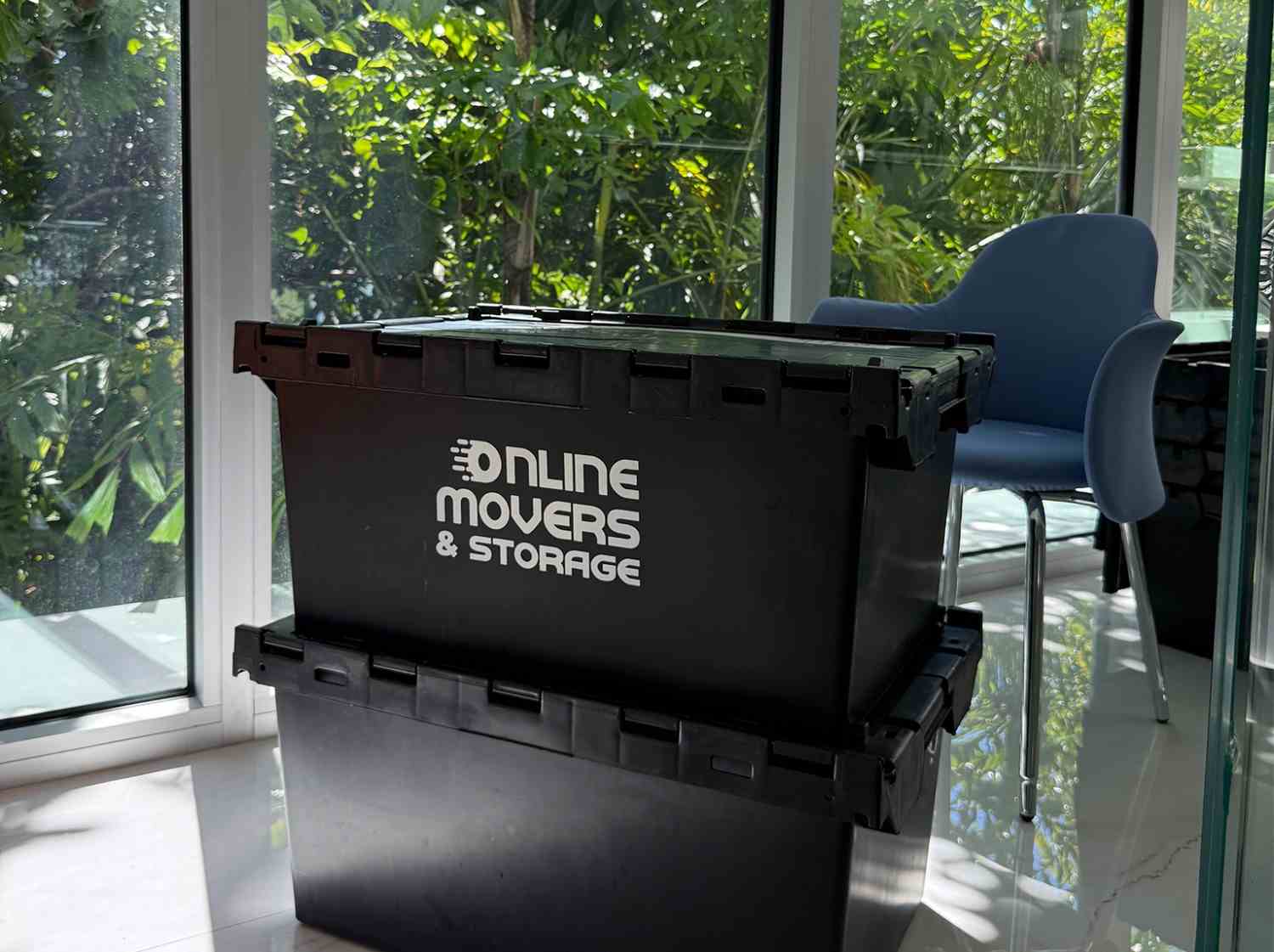
With the right professionals, things such as packing, disassembling, and reassembling furniture will be easy to handle, along with transportation and after-hours service provision. If you would like to get some assistance in organizing your relocation, consider using the professional office moving solutions provided by Online Movers & Storage.
Frequently Asked Questions
1. When should I start the planning process of relocating my office?
The best time to start is at least 6-8 weeks prior to the actual move. However, larger companies will require extra time for coordination of their people, inventory, IT systems, packing, and access to the building.
2. Is there any way to relocate my office without interrupting work?
Make an elaborate moving plan, pre-plan your IT systems, inform your employees and customers, and think about moving your office during off-hours.
3. What items need to be included in the checklist for the office move?
The checklist has to include the following. They include budgeting, moving schedules, office furniture inventory, information technology systems preparations, communication with employees, packing, transport, access to the building, and setting up after relocation.
4. When is the best time to move offices?
It can be evenings, weekends, or public holidays since these times may not cause much trouble in business activities. Take into account Miami traffic, access to the building, and employees’ availability.
5. Is it better to use office movers for relocation?
Professional office movers will assist in packing, disassembling and assembling furniture, loading and transporting items, unloading, and installing furniture in their place.